Complete Guide to Rhythmic Gymnastics Competition Music
Music in rhythmic gymnastics is not simply background.
It helps define the character of the routine, establishes its structure and tempo, creates opportunities for choreography, and influences how body movement and apparatus work are perceived together.
That is why choosing competition music involves much more than finding a song the gymnast likes.
Coaches and parents need to consider:
This guide brings those decisions together into one practical process. It is designed as a starting point for selecting rhythmic gymnastics competition music — with links to more detailed guides for each topic.
Quick Answer: What Makes Good Competition Music?
Good competition music should:
| Requirement | What it means |
|---|---|
| Fit the gymnast | Match her age, technical level, and artistic qualities |
| Have a clear character | Give the routine an identifiable artistic direction |
| Provide musical structure | Phrases, accents, contrasts, and development should support choreography |
| Work with the apparatus | Create opportunities for body and apparatus movement |
| Use a manageable tempo | The gymnast must be able to interpret the music while maintaining execution |
| Meet competition rules | Including applicable duration and music requirements |
| Use appropriate content | Lyrics and themes need to comply with applicable rules |
| Sound professional | The final competition file should be clean and reliable |
| Be properly licensed | Rights should cover the intended competition and performance use |
The objective is not simply to find a great track.
It is to find a great track for this gymnast, this apparatus, and this routine.
1. Understand the Competition Rules First
Before choosing music, know which rules apply. For FIG senior and junior individual exercises under the current Rhythmic Gymnastics Code of Points 2025–2028, the exercise duration is:
1 minute 15 seconds to 1 minute 30 seconds
Timing begins with the gymnast's first movement and ends when the gymnast is totally motionless.
The Code also establishes music as an integral part of the composition.
Music helps determine the:
Body and apparatus movements should relate to musical phrases, accents, tempo, and dynamic changes. This means compliance with the time limit is only the beginning. The music also needs to work as music for choreography.
Read: FIG Rhythmic Gymnastics Music Rules 2025–2028: What You Need to Know →
2. Start With the Gymnast
One of the most common mistakes in music selection is starting with the song.
Someone hears a track and says:
"This would be perfect for rhythmic gymnastics."
The better question is:
"For which gymnast?"
FIG specifically identifies the gymnast's age, technical level, and artistic qualities as considerations in music selection. So before searching for music, define the athlete. Ask:
- How old is she?
- What is her technical level?
- How does she naturally move?
- What kind of expression comes naturally?
- Is she powerful or delicate?
- Playful or restrained? Sharp or fluid?
- Does she hear musical accents easily?
- Can she sustain longer musical phrases?
- Does she enjoy theatrical performance?
- Can she convincingly carry dramatic music?
The basic principle
Gymnast → Character → Music
Not: Music → Try to make the gymnast fit
Read: How to Choose Rhythmic Gymnastics Music That Matches the Gymnast →
3. Consider Age and Technical Level
Music should challenge a gymnast artistically without overwhelming her technically. This is particularly important for children and developing athletes.
Younger does not automatically mean "cute"
A young gymnast can perform:
Age-appropriate does not mean childish. The question is whether the gymnast can understand and convincingly communicate the character.
Technical level matters too
Complex music may contain irregular phrases, frequent tempo changes, rapid accents, layered rhythms, unexpected transitions, or multiple dynamic changes.
These can provide excellent choreographic opportunities for an experienced gymnast. For a developing athlete, they may make the routine unnecessarily difficult.
A useful test
- Can she hear the music?
- Can she respond to it?
- Can she maintain apparatus control?
- Can she still perform the character?
If not, the track may be too complex for her current level.
Read: How to Choose Rhythmic Gymnastics Music for Kids and Junior Gymnasts →
4. Choose a Character Before Choosing a Genre
Instead of immediately deciding:
"We need classical music." or "Let's find a tango."
First define what the routine should communicate. Possible directions include:
Powerful, Elegant, Dramatic, Playful, Mysterious, Emotional, Dynamic, Delicate, Epic, Adventurous.
Then explore genres that can express that character.
Style and character are different
- Classical music can be delicate. But it can also be powerful or playful.
- Cinematic music can be epic. But it can also be mysterious or emotional.
- Modern music can be energetic or minimal.
Character → Style rather than: style → assumed character
Read: Rhythmic Gymnastics Music by Style: Classical, Tango, Spanish, Dramatic, Playful or Modern? →
5. Match the Music to the Apparatus
There is no FIG rule stating that each apparatus requires a particular genre.
Instead, consider what the apparatus can show inside the music.
Ribbon
Listen for phrasing, development, continuity, dynamic changes, and musical lines that can support large visual patterns.
Ball
Consider character, phrasing, contrasts, sustained musical moments, and accents that can support the relationship between body and apparatus.
Browse Ball Music →Hoop
Clear structure, contrasting sections, accents, and changes in intensity can create opportunities for varied apparatus handling.
Browse Hoop Music →Clubs
Rhythmic detail, accents, dynamic changes, and tempo can be particularly useful — provided the gymnast can interpret them without sacrificing execution.
Browse Clubs Music →Rope
Rhythmic clarity, pace, character, and recognizable phrases can provide useful material for rope choreography where rope is included in the applicable competition program.
Browse Rope Music →Floor
Floor/freehand routines appear in some developmental programs. Selection can focus particularly strongly on body expression, character, phrases, and dynamics.
Browse Floor Music →Read: How to Choose Rhythmic Gymnastics Music for Each Apparatus →
6. Find the Right Tempo
There is no universal ideal BPM for rhythmic gymnastics. And there is no FIG rule assigning a particular tempo to an apparatus.
Fast music
Can provide energy, rhythmic detail, frequent accents, and momentum.
But it can also cause the gymnast to:
- rush; miss accents;
- shorten body movements;
- lose apparatus control; sacrifice expression.
Slower music
Can provide longer phrases, sustained movement, space for expression, and subtle dynamic development.
But slow does not automatically mean easy:
With fewer obvious rhythmic cues, the gymnast may need greater control to sustain the musical character.
The right tempo is therefore:
"The tempo the gymnast can interpret while maintaining strong technical execution."
7. Listen for Structure, Not Just Melody
A beautiful melody does not automatically make good competition music. Listen deeper. Does the track contain:
- PhrasesCan you hear complete musical ideas?
- AccentsAre there identifiable moments the choreography can use?
- DynamicsDoes intensity change?
- ContrastDoes the music develop, or does it remain essentially the same?
- ClimaxIs there a meaningful high point?
- EndingDoes the music give the gymnast a convincing final moment?
A useful short-form structure might look like:
Character → Development → Contrast → Build → Climax → Ending
The exact structure can vary enormously. What matters is that the music gives the routine somewhere to go.
8. Lyrics Are Possible — But Check Them Carefully
A common question is: "Can rhythmic gymnastics music have words?"
The current FIG framework does not impose a blanket prohibition on sung lyrics. However, musical character and ethical content remain regulated. The Code addresses inappropriate content including elements such as swearing, dirty talk, violence, and discrimination. Spoken-word material also needs particular attention under the current musical-character provisions.
Before using vocal music:
- Read the complete lyrics
- Check the exact section used
- Translate foreign-language lyrics
- Consider age appropriateness
- Check the final lyrics again after editing
- Confirm compliance with the applicable rules
Do not assume that a song is suitable simply because the gymnast does not understand the language.
Read: Words vs. No Words: Can Rhythmic Gymnastics Music Have Lyrics? →
9. Competition Duration Changes How Music Works
Most commercial songs are much longer than a rhythmic gymnastics routine. A four-minute song therefore needs to become a short competition composition.
Simply cutting the file at 1:30 usually produces a weak result.
Instead, preserve the musical story
- Remove unnecessary repetition before destroying important musical development.
- Try to make cuts around logical musical boundaries rather than through the middle of phrases.
- And give the gymnast a deliberate ending rather than stopping the file because the clock reached 1:30.
Read: How to Cut and Edit Music for a Rhythmic Gymnastics Routine →
10. Purpose-Built Competition Music Is Another Option
Editing an existing song is not the only approach. Music can also be composed specifically around the needs of rhythmic gymnastics.
That allows the short-form structure to be considered from the beginning: competition duration, character, phrasing, accents, contrast, dynamic development, climax, and ending.
This is the approach behind RG Music.
Original compositions are created around rhythmic gymnastics rather than simply shortened from longer commercial tracks.
Listen to an Example
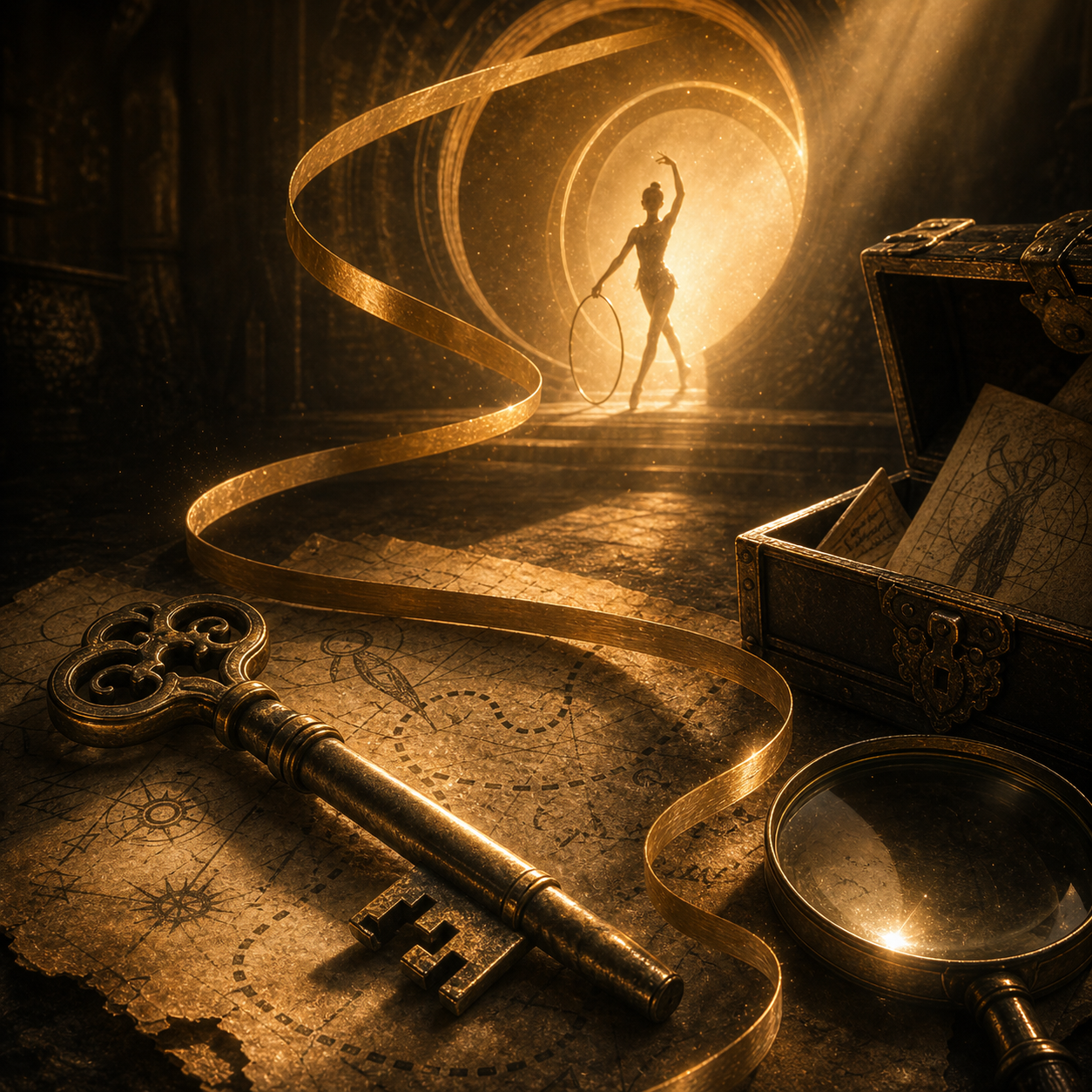
Hidden Clues
"A mysterious, searching composition that moves between curiosity, suspense, and growing intensity through changes in rhythm."
This also demonstrates why one composition does not need to belong exclusively to one apparatus. The same musical structure can produce very different choreography depending on the gymnast and apparatus.
11. Audio Quality Matters
A competition soundtrack may be played through a large sound system in a gymnasium or arena. Problems that seem minor through a phone speaker can become much more noticeable through a larger playback system.
These may include: compression artifacts, clipping, abrupt edits, excessive noise, inconsistent levels, distortion, and poor-quality source audio.
Start with the best source available
High-Quality Source → Edit → Master → Competition File
Avoid repeatedly exporting through lossy formats when unnecessary.
WAV does not automatically mean high quality
Converting a low-quality MP3 into WAV does not restore audio information lost during the original compression. The quality of the source still matters.
Also remember that FIG does not award extra points because the file is WAV. Submission requirements may depend on the competition directives.
Read: Why Professional Audio Quality Matters for Rhythmic Gymnastics Competition Music →
12. Check Music Rights and Licensing
Technical compliance with FIG rules and copyright permission are two different questions. A track may be perfectly suitable under competition rules while still being protected by copyright.
Coaches, clubs, parents, and event organizers should therefore consider how the music is licensed for its intended use.
Questions worth asking
- • Can the track be used in competition? Internationally? Repeatedly?
- • Can the gymnast train and publicly perform with it?
- • Does the license expire? Does it cover the intended type of performance?
- • Does publishing a competition video online involve additional rights?
The answers depend on the specific music and license. Do not assume that purchasing or streaming a song automatically provides every right required for every use.
RG Music licensing
RG Music tracks are offered with licensing designed for rhythmic gymnastics competition and training use.
13. Don't Choose Music Only Because It Is Popular
A trending song can be attractive because the gymnast already knows it, the audience recognizes it, or the coach immediately understands the character.
But popularity does not necessarily make it the strongest competition choice. Consider:
- Does it actually fit the gymnast?
- Does it fit the apparatus?
- Can it be edited coherently?
- Is the character appropriate?
- Are the lyrics suitable?
- Will many other gymnasts use the same track?
- Does the music provide enough choreographic information?
- Can it produce a distinctive routine?
Original music can provide another route when the goal is to create a more individual musical identity.
14. Compare Several Tracks Before Making the Final Decision
Avoid committing after one listen. Choose two or three candidates. Then test them with the gymnast.
Listen for:
Sometimes the track everyone initially liked most becomes the weakest choice once the gymnast starts moving.
A Complete Music Selection Workflow
Here is the entire process in one view.
RULES
Federation · Level · Duration · Music requirements
GYMNAST
Age · Technical level · Artistic qualities
CHARACTER
Powerful · Elegant · Playful · Dramatic · Emotional · etc.
APPARATUS
Ribbon · Ball · Hoop · Clubs · Rope · Floor where applicable
MUSIC DIRECTION
Style · Mood · Tempo
STRUCTURE
Phrases · Accents · Dynamics · Contrast · Climax
TEST
2–3 candidate tracks with the gymnast
FINAL MUSIC
Competition-ready track or edited composition
TECHNICAL CHECK
Duration · Audio quality · Final export
RIGHTS
Confirm appropriate competition/performance licensing
CHOREOGRAPHY
BODY + APPARATUS + MUSIC = ONE COMPOSITION
Three Examples From the RG Music Catalog
Different gymnasts may need completely different musical directions.
For a mysterious, dramatic Elite character
Hidden Clues
"Hidden Clues has a mysterious, searching character, as if following clues and slowly uncovering something unknown. Changes in rhythm move the music between curiosity, suspense, and growing intensity, creating a sense of discovery and anticipation."
For a bright Junior character

Sparkling Steps
"Sparkling Steps is a bright and playful orchestral piece filled with sparkling melodies, lively rhythms, and graceful energy. Light, elegant, and full of movement, it blends classical charm with a cheerful spirit."
For a powerful Elite performance

Breaking Through
"Breaking Through is a powerful cinematic rock track driven by energetic guitars, punchy drums, and dynamic builds. Bold, dramatic, and full of momentum, it delivers an intense modern sound"
These tracks are very different. That is the point.
There is no single sound of "good rhythmic gymnastics music." The correct choice depends on the athlete and the composition being created.
Frequently Asked Questions
What is the best music for rhythmic gymnastics?
There is no universally best genre. The strongest choice is music that fits the gymnast's age, technical level, artistic qualities, apparatus, and intended character while providing useful musical structure for choreography.
Read Music That Matches the Gymnast →How long should rhythmic gymnastics music be?
For FIG senior and junior individual exercises under the current Code, the duration is 1:15–1:30. Other programs may have different requirements.
Read FIG Rhythmic Gymnastics Music Rules →Can rhythmic gymnastics music have lyrics?
The current FIG rules do not impose a blanket prohibition on sung lyrics, but musical character and ethical content requirements apply.
Read Words vs. No Words →What music is best for ribbon?
There is no required ribbon genre. Look for music whose phrasing, character, dynamics, and development provide useful opportunities for ribbon choreography and fit the gymnast.
What music is best for hoop, ball, or clubs?
There is no FIG-prescribed genre for individual apparatus. Choose based on the gymnast first, then consider what the apparatus can express through the music.
Read Music for Each Apparatus →What music is best for young rhythmic gymnasts?
Look for a character the gymnast can genuinely communicate and a musical structure and tempo she can manage while maintaining technical execution. Age-appropriate does not necessarily mean childish.
Read Music for Kids and Junior Gymnasts →How do I cut a song for a rhythmic gymnastics routine?
Map the original musical structure first. Preserve important phrases, remove unnecessary repetition, create clean transitions, and build a deliberate ending within the required duration.
Read How to Cut and Edit Music →Is WAV better than MP3 for competition music?
Lossless source and master files preserve audio information that lossy compression can discard, but simply converting an MP3 into WAV does not improve the original quality. Competition submission formats should always be checked in the applicable event directives.
Read Why Audio Quality Matters →Complete Competition Music Checklist
Before finalizing a routine, check all four areas.
Gymnast
Music
Choreography
Competition
Need Help Choosing Music?
Tell us a bit about your gymnast, and we'll help you find the perfect track for her next routine.
The Complete RG Music Guide
If you are building a new rhythmic gymnastics routine, use these guides depending on where you are in the process:
| Your question | Read this guide |
|---|---|
| What are the current music rules? | FIG Rhythmic Gymnastics Music Rules 2025–2028 |
| How do I choose music for Ribbon? | How to Choose the Perfect Music for a Ribbon Routine |
| Can we use music with lyrics? | Words vs. No Words |
| Does WAV/MP3 quality matter? | Why Professional Audio Quality Matters |
| Which musical style should we choose? | Rhythmic Gymnastics Music by Style |
| How should music differ by apparatus? | Music for Each Apparatus |
| How do I choose music for a child or Junior? | Music for Kids and Junior Gymnasts |
| How do I match music to the athlete? | Music That Matches the Gymnast |
| How do I make a competition-length edit? | How to Cut and Edit Music for a Rhythmic Gymnastics Routine |
Final Takeaway
Choosing rhythmic gymnastics competition music is not one decision.
It is a sequence of decisions:
Start with the applicable competition rules.
Understand the gymnast. Find a character she can genuinely perform.
Choose music with structure, phrases, accents, dynamics, and a tempo she can control.
Make sure the apparatus can become part of the musical interpretation.
Then verify duration, audio quality, and licensing.
When all of these elements work together, music stops functioning as background. It becomes part of the routine itself.
Find Music for Your Next Routine
Explore original competition music created for rhythmic gymnastics and browse by apparatus, mood, style, tempo, and level.
Sources
- Fédération Internationale de Gymnastique (FIG / World Gymnastics), Rhythmic Gymnastics Code of Points 2025–2028, current version valid from April 1, 2025. Official source for individual exercise duration, music requirements, music selection, Artistry, musical structure, character, rhythm, and the relationship between music and movement. World Gymnastics — Official Rules Repository
- Fédération Internationale de Gymnastique (FIG / World Gymnastics), Rhythmic Gymnastics Code of Points 2025–2028. Individual Exercises — Generalities and Artistry. FIG Rhythmic Gymnastics Code of Points 2025–2028
- USA Gymnastics, Rhythmic Gymnastics Development Program, useful when working with U.S. developmental levels whose requirements should not be assumed to be identical to FIG senior/junior rules. USA Gymnastics — Rhythmic Development Program