Choosing Rhythmic Gymnastics Music to Match the Gymnast
The best rhythmic gymnastics music is not necessarily the most dramatic track, the most popular song, or the piece the coach likes most.
It is the music that this particular gymnast can perform convincingly.
Under the FIG Rhythmic Gymnastics Code of Points 2025–2028, music selection should take into account the gymnast's age, technical level, and artistic qualities. The selected music should allow the gymnast to perform at her best and support the best possible execution.
This gives coaches a useful starting principle:
Don't start with "What song do we like?"
Start with "Who is this gymnast on the carpet?"
This guide provides a practical framework for matching rhythmic gymnastics competition music to the athlete.
Quick Answer: How Do You Choose the Right Music for a Gymnast?
Evaluate six things:
| Factor | Main question |
|---|---|
| Age | Is the character believable and appropriate? |
| Technical level | Can she execute reliably at this tempo and complexity? |
| Artistic qualities | Does the music reveal what she naturally does well? |
| Character | Can she convincingly sustain this musical identity? |
| Musical structure | Can she hear and respond to phrases, accents, and dynamics? |
| Apparatus | Does the music create useful opportunities for the apparatus? |
A strong match happens when these factors work together. The goal is not simply:
GOOD MUSIC
It is:
RIGHT MUSIC × RIGHT GYMNAST
1. Start With the Gymnast — Not the Track
Music selection often begins backwards. Someone hears a song and says: "This would be amazing for rhythmic gymnastics." Maybe. But the first question should be: "For which gymnast?"
The same composition can look completely different when performed by two athletes.
One gymnast may naturally project:
Power · Confidence · Sharpness · Intensity
Another:
Elegance · Softness · Sensitivity · Flow
Another:
Playfulness · Energy · Humor · Character
Another:
Mystery · Restraint · Precision · Drama
None of these profiles is inherently better.
The purpose of music selection is to find material that reveals the athlete's strengths rather than hiding them.
2. Identify the Gymnast's Natural Artistic Qualities
Before opening a music catalog, observe the gymnast without trying to assign her a genre. Ask the coaching team:
How does she naturally move?
Sharp or fluid? Large or detailed? Explosive or controlled? Light or grounded? Quick or sustained?
How does she perform?
Does she naturally engage the audience? Does she enjoy theatrical characters? Is she expressive through her face? Is her strength primarily body expression? Does she communicate intensity well? Is subtle expression stronger than obvious drama?
How does she respond to music?
Does she immediately hear accents? Does she understand longer phrases? Does she naturally change movement quality when the music changes? Does she tend to rush? Does she need very clear rhythmic information?
These observations are more useful than beginning with: "Let's find a tango."
3. Define the Character Before the Genre
Once you understand the gymnast, define the character you want the routine to communicate. For example: Powerful, Elegant, Playful, Mysterious, Emotional, Dynamic, Delicate, Adventurous.
Only then begin exploring genres.
Character and genre are not the same thing
- "Dramatic" is not necessarily a genre.
- "Classical" is not necessarily elegant.
- "Cinematic" is not necessarily powerful.
- "Tango" is not automatically mature.
One genre can contain many characters. For example, CLASSICAL music can be:
This is why searching by mood + style + tempo can be more effective than searching by genre alone.
4. Choose Music the Gymnast Can Actually Interpret
There is an important difference between:
A gymnast can memorize exactly when to perform every movement without genuinely responding to the musical structure.
FIG Artistry goes further. Body and apparatus movements should relate to musical phrases, accents, tempo, and dynamic changes. So when testing a track, don't immediately teach choreography. Play the music and observe.
Try this simple test
Ask the gymnast to move freely for 20–30 seconds. Don't tell her exactly what to do. Watch:
- Does she notice the important accents?
- Does her movement change when the music changes?
- Does she anticipate phrases?
- Does the character appear naturally?
- Does she look comfortable or self-conscious?
You are not evaluating choreography. You are evaluating the connection between athlete and music.
5. Don't Force a Character That Isn't There
A powerful dramatic track can sound spectacular. But if the gymnast naturally performs with softness and restraint, the music may constantly demand something she has to manufacture.
The reverse is also true. A naturally explosive gymnast may appear constrained by music that requires sustained delicacy she cannot yet communicate.
Ask one useful question
"Does the music amplify her — or does she spend the entire routine fighting it?"
Good music does not necessarily make the routine easier. But it should give the gymnast something authentic to work with.
6. Match the Tempo to the Athlete
Tempo is not simply about whether the gymnast is physically fast enough. It affects the entire relationship between:
Music → Body → Apparatus → Choreography
With faster music, ask:
- Can she recognize the accents?
- Can she complete apparatus actions without rushing?
- Can she maintain expression?
- Can she still differentiate important musical moments?
- Does her body movement remain finished?
With slower music, ask:
- Can she sustain movement through longer phrases?
- Can she maintain character without constant rhythmic cues?
- Does the routine become empty between technical elements?
- Can she create intensity without relying on speed?
There is no ideal BPM
FIG does not prescribe a specific tempo for an individual apparatus or type of gymnast. The correct tempo is one the gymnast can interpret while maintaining strong execution.
7. Match Musical Complexity to the Athlete
Two tracks can have approximately the same tempo and still be completely different in difficulty. Consider:
Track A
- Clear 8-count phrases
- Recognizable accents
- Predictable development
- Few major changes
Track B
- Irregular phrasing
- Frequent rhythmic changes
- Layered instrumentation
- Unexpected accents
- Multiple changes in intensity
- Complex transitions
Track B is not automatically "better music." For the right athlete, it can provide exceptional choreographic possibilities. For another gymnast, it can create a routine in which she is permanently half a second behind the music.
Complexity should create opportunity
The purpose of sophisticated music is not to demonstrate sophisticated taste. It is to give the gymnast musical information she can actually use.
8. Use Contrast to Reveal Different Sides of the Gymnast
A strong competition track does not necessarily maintain one character or intensity for 90 seconds. Contrast can reveal range. For example:
The gymnast now has opportunities to demonstrate different movement qualities while maintaining one coherent composition. FIG Artistry specifically addresses dynamic changes reflecting contrasts in the music.
But don't demand too many personalities
Contrast is different from inconsistency. If the music changes character every ten seconds, the gymnast may never have enough time to establish a clear artistic identity. The routine should still feel like one composition.
9. Consider the Apparatus After You Find the Direction
Once you have found music that genuinely suits the gymnast, consider how it works with the apparatus. Ask:
- What can Ribbon show in this music?
- What can Ball show?
- What can Hoop show?
- What can Clubs show?
- What can Rope show?
The apparatus should become another layer of musical interpretation.
Example
Imagine a gymnast who performs particularly well with mysterious, controlled, gradually intensifying music. A track like Hidden Clues could provide one possible direction.

Hidden Clues
"A mysterious, searching composition that moves between curiosity, suspense, and growing intensity through changes in rhythm."
The reason to choose this track should not simply be:
"It's dramatic."
It should be:
"This gymnast can sustain its mysterious character, respond to its development, and use its changes in intensity through her body and apparatus."
Read: How to Choose Rhythmic Gymnastics Music for Each Apparatus →
10. Match the Emotional Scale to the Gymnast
Some music asks very little emotionally. Other music demands a lot. Consider a delicate, emotionally developing composition.
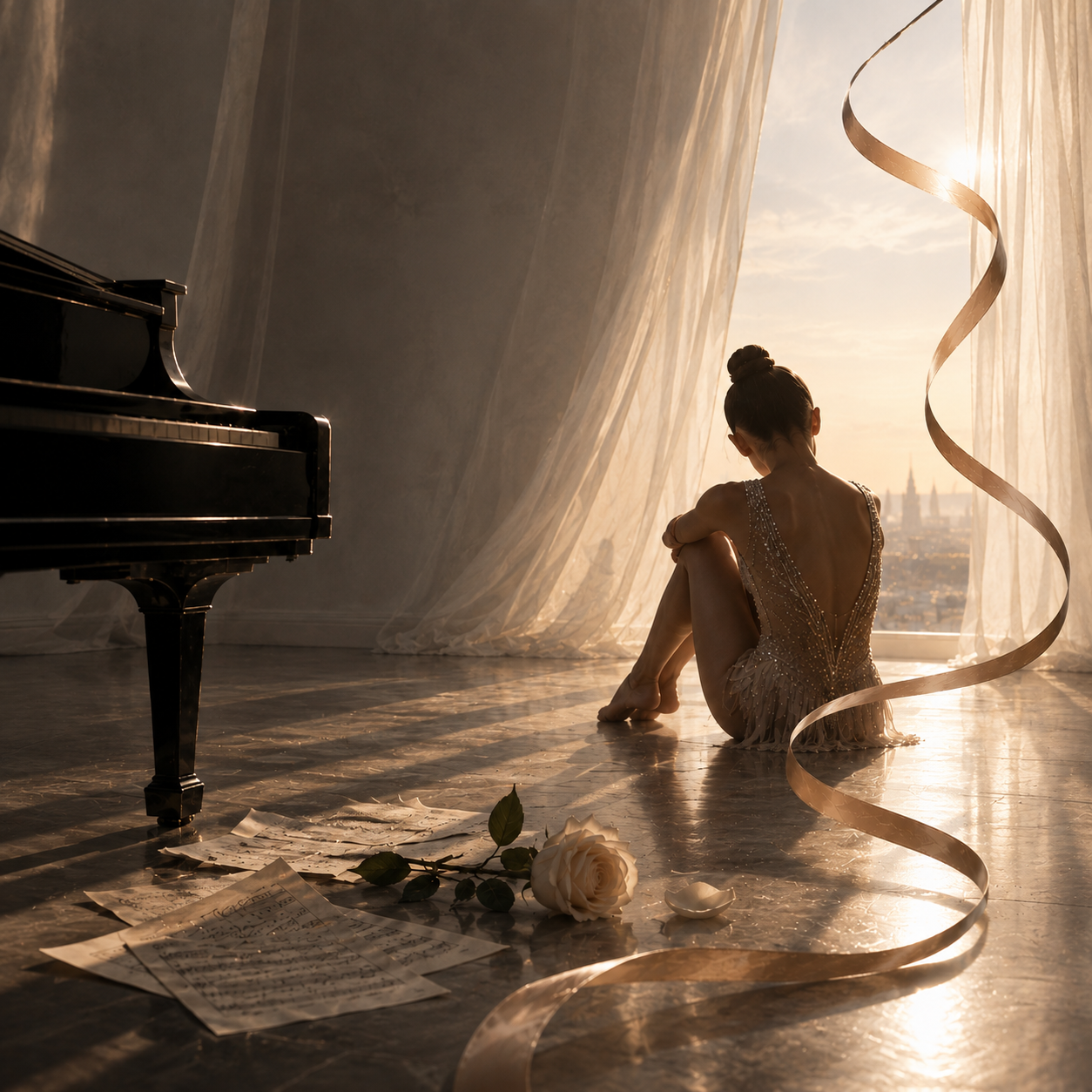
Before the Goodbye
"A delicate piano melody and expressive strings move from quiet, vulnerable moments toward heavier dramatic passages with a stronger pulse and pronounced accents."
This type of music may provide beautiful possibilities for a gymnast with strong body expression and sensitivity to longer phrases.
But giving it to an athlete simply because the track is beautiful does not guarantee a strong composition.
The gymnast needs to be able to carry the quiet moments as well as the dramatic ones.
11. For Younger Gymnasts, Character Can Be More Immediate
Younger gymnasts often benefit from musical ideas they can understand intuitively. That does not mean the music must be childish. Adventure, discovery, mischief, magic, celebration, or playfulness can provide clear imaginative frameworks.

Pirates Treasure
"A lively pirate adventure full of daring escapes, hidden treasures, and unexpected twists, with bold rhythms and playful energy."
For the right young gymnast, an immediately understandable character can make it easier to connect:
MUSIC → IDEA → MOVEMENT → EXPRESSION
Read: How to Choose Rhythmic Gymnastics Music for Kids and Junior Gymnasts →
12. Don't Ignore the Gymnast's Own Reaction
The coach brings expertise. The choreographer understands composition. Parents may have preferences. But the gymnast is the person who has to live with the music.
She may hear it hundreds of times during the season. Her response therefore matters.
Instead of only asking "Do you like this one?", try:
- What do you think is happening in this music?
- Which part feels most like you?
- What do you imagine when you hear it?
- Which part makes you want to move?
- Which track would you be excited to perform in front of people?
These questions reveal whether the gymnast has begun to form an actual relationship with the music.
13. Test Two or Three Tracks Before Deciding
Don't necessarily make the final decision after one listen. Choose two or three strong candidates. Then test them.
Candidate A
Perhaps powerful and cinematic.
Candidate B
Perhaps elegant and classical.
Candidate C
Perhaps playful and rhythmic.
Let the gymnast move to each. Try small apparatus combinations. Observe her expression. Watch what happens when she stops thinking about the steps.
Sometimes the track that looked strongest on paper is clearly wrong once the gymnast starts moving.
A Practical Music–Gymnast Matching Scorecard
This is not an FIG scoring system. It is a practical decision tool for coaches. Score each candidate from 1 to 5.
| Question | Track A | Track B | Track C |
|---|---|---|---|
| Fits the gymnast's age | /5 | /5 | /5 |
| Fits her technical level | /5 | /5 | /5 |
| Matches her natural movement quality | /5 | /5 | /5 |
| Character feels authentic | /5 | /5 | /5 |
| Tempo is manageable | /5 | /5 | /5 |
| Musical structure is readable | /5 | /5 | /5 |
| She responds naturally to accents | /5 | /5 | /5 |
| Dynamic changes create opportunities | /5 | /5 | /5 |
| Works with the apparatus | /5 | /5 | /5 |
| She genuinely connects with it | /5 | /5 | /5 |
| Strong ending is possible | /5 | /5 | /5 |
| Total | /55 | /55 | /55 |
The total is not the final decision. More important is identifying where each track is weak.
A track scoring 5/5 for character but 2/5 for technical fit may create more problems than opportunities.
A Better Music Selection Process
Instead of:
Use:
This changes music selection from taste into a choreographic decision.
Frequently Asked Questions
How do I choose music for a rhythmic gymnastics routine?
Start with the gymnast's age, technical level, and artistic qualities. Then define a character she can perform convincingly and search for music with a suitable tempo, structure, phrases, accents, and dynamics. Finally, evaluate how the music works with the apparatus and choreography.
Should the gymnast choose her own music?
The gymnast's preference is important, but it should be combined with professional coaching and choreographic judgment. A gymnast may love a song that does not suit her technical level, apparatus, or artistic strengths. The strongest decision usually considers both athlete connection and coaching expertise.
What if the coach and gymnast prefer different tracks?
Test both. Have the gymnast move to each track rather than deciding entirely through discussion. Observe musical response, expression, movement quality, and apparatus control. The practical test often makes the stronger choice clearer.
Should music match the gymnast's personality?
Not necessarily her everyday personality. A quiet gymnast can be powerful on the carpet. An energetic child can perform elegant music beautifully. What matters is her performance identity — what she can communicate convincingly through movement.
Should rhythmic gymnastics music match the apparatus or the gymnast first?
Start with the gymnast and the intended character, then evaluate the apparatus. There is no FIG rule assigning specific genres to ribbon, ball, hoop, clubs, or rope.
Read Music for Each Apparatus →How do I choose music for a young gymnast?
Consider age, technical level, artistic qualities, musical complexity, and whether the character feels authentic.
Read Music for Kids & Junior Gymnasts →Does the gymnast need to like the music?
There is no FIG rule requiring personal preference, but in practice the athlete's connection with the track is worth considering because she must interpret and repeatedly train to it. Preference alone, however, should not override technical and artistic suitability.
Final Music Selection Checklist
Before committing to the track:
Need Help Choosing Music?
Tell us a bit about your gymnast, and we'll help you find the perfect track for her next routine.
Final Takeaway
Great rhythmic gymnastics music does more than accompany a routine.
It reveals the gymnast.
The selection process should therefore begin not with genre, apparatus, or a favorite song, but with the athlete:
Then find music that makes those qualities more visible. The strongest match happens when:
begin to feel like one composition.
That is when music stops being background — and starts becoming movement.
Find Music That Matches Your Gymnast
Explore original rhythmic gymnastics competition music by mood, style, tempo, level, and apparatus.
Browse Competition MusicSources
- Fédération Internationale de Gymnastique (FIG / World Gymnastics), Rhythmic Gymnastics Code of Points 2025–2028, version valid from April 1, 2025. Individual Exercises — Artistry. The Code addresses music selection in relation to age, technical level, artistic qualities, and the gymnast's ability to perform at her best. World Gymnastics — Official Rules Repository
- Fédération Internationale de Gymnastique (FIG / World Gymnastics), Rhythmic Gymnastics Code of Points 2025–2028, Individual Exercises — Artistry. Relevant provisions cover the role of music in establishing structure, tempo, guiding idea and emotions, and the relationship between movement and musical phrases, accents, and dynamic changes. FIG Rhythmic Gymnastics Code of Points 2025–2028