Gymnastics Music Styles: Classical, Tango, Dramatic & More
There is no single musical style that is “best” for rhythmic gymnastics.
A classical piece can create an outstanding routine. So can tango, cinematic music, modern electronic music, playful character music, or a powerful dramatic composition.
Under the FIG Rhythmic Gymnastics Code of Points 2025–2028, the key question is not the genre itself. Music should help establish the structure, tempo, character, guiding idea, and emotion of the composition, while allowing the gymnast to perform at her best.
So instead of asking:
"What style is best for rhythmic gymnastics?"
A more useful question is:
"What musical style best reveals this gymnast and gives the choreographer material to build the routine?"
This guide compares some of the most useful styles for rhythmic gymnastics competition music and explains what coaches should listen for when choosing between them.
Quick Guide
Rhythmic Gymnastics Music Styles
| Style | Musical qualities to look for | Can work well when... |
|---|---|---|
| Classical | Clear phrasing, dynamics, orchestral development | The gymnast can sustain musical interpretation and movement quality |
| Tango | Strong accents, rhythmic identity, tension and release | The gymnast can express a distinct, mature character |
| Spanish-inspired | Rhythmic energy, recognizable character, accents | The choreography can use the rhythm without becoming stereotypical |
| Dramatic | Contrast, build, powerful accents, emotional development | The gymnast can carry intensity throughout the routine |
| Playful | Light accents, changes, character, rhythmic surprises | The gymnast naturally communicates personality and timing |
| Modern | Contemporary rhythm, textures, unusual structure | The gymnast and choreography suit a less traditional character |
| Epic / Cinematic | Large dynamic development, climaxes, contrast | The routine needs scale and strong musical progression |
| Soft / Emotional | Melody, phrasing, subtle dynamics | The gymnast can maintain expression without relying on obvious accents |
These are creative categories, not FIG classifications. FIG does not assign particular genres to particular apparatus.
1. Classical Music for Rhythmic Gymnastics
Classical music has a long natural relationship with movement-based sports and performance. But "classical" covers an enormous range.
A delicate piano composition and a dramatic orchestral finale may both be classical while creating completely different possibilities for choreography.
What to listen for
Look beyond whether the melody is beautiful. Listen for:
- clear musical phraseschanges in dynamicsidentifiable accentschanges in instrumentationcontrast between sectionsdevelopment toward a climaxa convincing ending
When classical music can work especially well
Classical music can be a strong choice when the gymnast is capable of maintaining movement quality and character through longer musical phrases.
It can also give a choreographer substantial material for changes in:
But classical does not automatically mean elegant or slow. A classical composition can be energetic, playful, aggressive, mysterious, romantic, or monumental.
Listen to a Classical Example

Sparkling Steps
"A bright and playful orchestral piece with sparkling melodies, lively rhythms, and graceful energy."
Common mistake
Choosing famous classical music simply because it sounds "appropriate for gymnastics."
Familiarity is not enough. Ask whether this particular composition gives this particular gymnast useful musical information to interpret.
2. Tango Music for Rhythmic Gymnastics
Tango has several characteristics that can make it attractive for rhythmic gymnastics choreography:
- a recognizable rhythmic identity
- pronounced accents
- tension and release
- changes between sharp and sustained musical material
- a strong sense of character
These qualities can give the choreographer clear moments to work with.
Tango can be effective when...
- The gymnast can communicate a strong and consistent character.
- The choreography can respond precisely to accents rather than simply moving at the same speed as the music.
- The routine can use contrast between sharper and more sustained movement.
- The gymnast is comfortable performing music with a pronounced identity.
The main risk
Tango has such a recognizable character that it is easy to fall into imitation. A routine does not become tango simply through a few stereotypical poses or gestures.
The more interesting approach is to interpret the musical qualities rather than illustrating a cliché.
3. Spanish Music for Rhythmic Gymnastics
Searches for Spanish music for rhythmic gymnastics are common because Spanish-inspired music can provide strong rhythm, recognizable character, and dramatic accents.
But "Spanish music" is itself a broad label. A track might draw inspiration from flamenco, orchestral Spanish music, Latin influences, guitar traditions, percussion, or contemporary cinematic interpretations.
Potentially useful characteristics include:
- pronounced rhythmic patternspercussionguitar accentsdynamic changesstrong musical identitymoments of tension and release
What to avoid
Do not choose Spanish-inspired music only because it immediately sounds "dramatic."
The gymnast still needs to be able to carry its character. And the choreography should respond to the actual structure and rhythm of the composition rather than rely entirely on recognizable Spanish-style gestures.
4. Dramatic gymnastics floor music
Dramatic gymnastics floor music is one of the most useful broad categories for competition routines because it can create a clear emotional direction.
But dramatic does not simply mean loud. Strong dramatic music usually develops.
That progression can give a choreographer multiple levels of intensity to interpret.
Listen to a Dramatic Example

Hidden Clues
"A mysterious, searching composition that moves between curiosity, suspense, and growing intensity through changes in rhythm."
What to listen for
- contrasting sections
- strong musical accents
- quieter moments
- gradual builds
- changes in instrumentation
- climactic moments
- a deliberate ending
The main risk
If everything is powerful, nothing feels powerful.
A track consisting of continuous maximum intensity can give the choreography fewer opportunities to demonstrate meaningful dynamic contrast. Contrast often makes the strongest moments feel stronger.
5. Upbeat gymnastics floor music
Playful, fast-paced, and upbeat gymnastics floor music can be extremely effective, particularly for gymnasts whose natural performance quality includes personality, lightness, quick reactions, humor, or theatrical expression. When you need confident gymnastics floor music or fun gymnastics floor music, this style gives the athlete a huge energy boost.
It can also be an excellent direction for younger gymnasts when the music suits their age and abilities. FIG specifically identifies age, technical level, and artistic qualities as considerations in music selection.
Listen to a Playful Example

Mischief Makers
"A playful, quirky instrumental track built around lively rhythms, humorous accents, and unexpected changes."
Why playful music can be difficult
Playful music often contains many small musical events. If the choreography tries to respond to every single sound, the result can become fragmented.
The objective is not:
movement → movement → gesture → accent → gesture → accent
Instead, the gymnast should still maintain an overall character and coherent composition.
6. Modern Music for Rhythmic Gymnastics
Modern competition music can include many different influences: electronic music, contemporary pop production, minimalism, cinematic sound design, modern percussion, hybrid orchestral production, or combinations of genres.
There is no FIG requirement that rhythmic gymnastics music sound classical or traditional. What matters is whether it satisfies the applicable music requirements and supports the composition.
Listen carefully to the structure
Some contemporary tracks rely heavily on repetitive beats or textures. That may sound compelling as a song but provide relatively little development within a 1:15–1:30 routine. Ask:
- What changes after the first 20 seconds?
- Where is the contrast?
- Where are the important musical moments?
- Where does the routine develop?
- What does the ending give us?
If those questions are difficult to answer, the track may require significant editing or may not be ideal for competition choreography.
Example of a modern sound with clear development: Breaking Through →
7. Epic and Cinematic Music for Rhythmic Gymnastics
Cinematic music can create a strong sense of scale in a short period. It often contains builds, orchestral layers, percussion, strong accents, changes in intensity, climaxes, and clear resolutions. That can make it particularly useful for competition editing.
Listen to an Epic Cinematic Example

Breaking Through
"Energetic guitars, punchy drums, and dynamic builds create a powerful modern cinematic progression."
Why it works
A 90-second routine needs to establish an idea, develop it, and reach a conclusion very quickly. Music written with a clear dramatic arc can naturally provide that structure.
But there is a challenge
The gymnast needs to match the scale of the music. A huge cinematic climax combined with movement that remains visually and emotionally unchanged can create a disconnect.
The stronger the musical development, the more important it becomes for the routine to reflect that development.
Looking for a lighter cinematic character? Explore Pirates Treasure, a medium-fast Junior composition with adventure and playful character.
Listen to Pirates Treasure8. Soft and Emotional Music for Rhythmic Gymnastics
Soft music is sometimes mistakenly considered easier. It is not.
With fewer obvious beats and dramatic accents, the gymnast may need greater sensitivity to: phrasing, melody, breath, subtle dynamic changes, transitions, and emotional development.
Listen to a Soft & Emotional Example
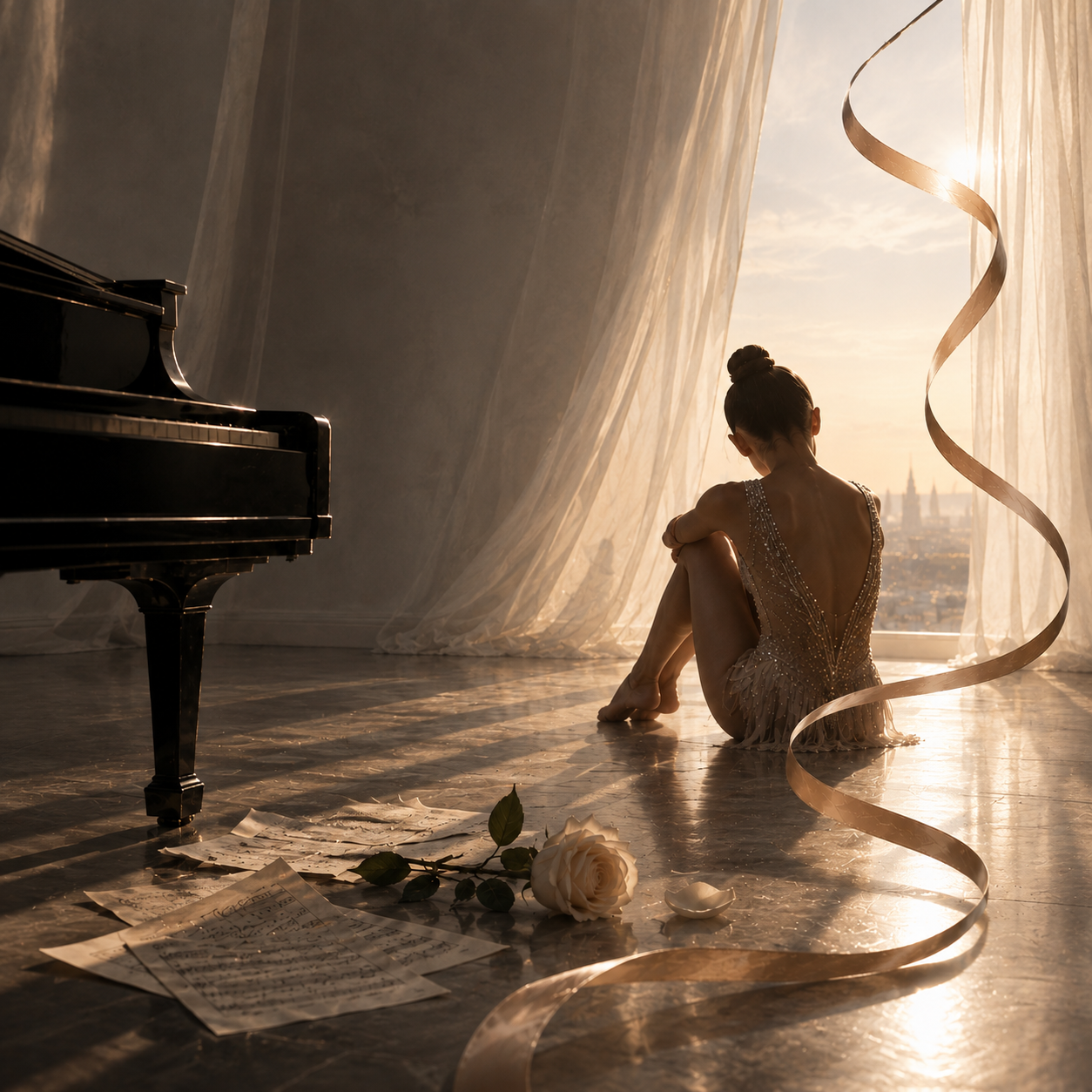
Before the Goodbye
"A delicate piano melody and expressive strings move from quiet, vulnerable moments toward heavier dramatic passages with a stronger pulse and pronounced accents."
The main risk
Soft music can become background music if the choreography does not actively interpret it. This is particularly relevant because FIG explicitly expects music to guide the composition rather than simply accompany technical elements.
Style Is Only One Dimension
Genre is useful for discovering music. But it should not be the final selection criterion. Two tracks labeled Dramatic can be completely different.
Example: one track, multiple dimensions
| Dimension | Hidden Clues |
|---|---|
| Style | Cinematic · Contemporary Classical · Orchestral |
| Mood | Mysterious · Dramatic · Dynamic |
| Tempo | Medium Fast |
| Level | Elite |
| Apparatus | Ribbon · Ball · Hoop · Clubs · Rope |
| Duration | 1:30 |
Does Each Apparatus Need a Different Music Style?
Not according to FIG.
There is no rule saying: Ribbon = classical, Ball = lyrical, Clubs = fast, Hoop = dramatic.
Different styles can work with different apparatus. The more useful question is: Does the relationship between this music, this gymnast, this choreography, and this apparatus make sense?
How to Choose Between Two Very Different Tracks
Imagine that a gymnast has narrowed the choice to Track A (Dramatic Tango) and Track B (Soft Emotional Piano). Don't decide only by asking which song everyone likes more. Score each candidate from 1–5 below:
| Question | Track A | Track B |
|---|---|---|
| Fits the gymnast's age | ||
| Fits her technical level | ||
| Fits her artistic qualities | ||
| Character feels natural | ||
| Musical phrases are usable | ||
| Accents support choreography | ||
| Contains useful dynamic contrast | ||
| Works with the apparatus | ||
| Can create a strong ending | ||
| Gymnast genuinely connects with it |
The numbers are not an FIG scoring system. They are simply a decision-making tool for the coach.
Start With Character, Then Narrow the Search
Instead of opening a music library and listening randomly to hundreds of tracks, use a simple sequence:
What are her strongest artistic qualities?
Powerful? Elegant? Playful? Mysterious? Emotional?
Classical? Tango? Spanish-inspired? Modern? Cinematic?
Can she comfortably maintain musicality and technical execution?
What opportunities does the music create for the apparatus?
Phrases? Accents? Contrast? Development? Ending?
Duration, FIG requirements, and appropriate music rights.
Frequently Asked Questions
What type of music is best for rhythmic gymnastics?
There is no single best genre.
Under the current FIG Code, music selection should consider the gymnast's age, technical level, and artistic qualities. Music should help establish the structure, tempo, guiding idea, character, and emotions of the composition. The best music is therefore the music that gives a particular gymnast the strongest opportunity to perform both technically and artistically.
Is classical music best for rhythmic gymnastics?
Not necessarily. Classical music can provide excellent phrasing, dynamics, and structure, but FIG does not give classical music preference over other genres.
Can you use tango for rhythmic gymnastics?
Yes, provided the specific music complies with applicable FIG requirements. Tango can offer strong rhythmic identity, accents, contrast, and character that can be useful for choreography.
Can you use Spanish music for rhythmic gymnastics?
Yes. There is no FIG prohibition against Spanish-inspired music as a genre. The gymnast and choreography should nevertheless respond to its musical structure and character.
Can rhythmic gymnastics use modern or electronic music?
Yes. FIG does not require rhythmic gymnastics music to belong to a traditional or classical genre. The applicable requirements concerning musical character, ethical content, and the relationship between music and choreography still apply.
What music is best for ribbon?
There is no required ribbon genre.
Rather than automatically choosing slow or classical music, consider whether the track provides suitable phrases, dynamics, character, and tempo for the gymnast and her choreography.
What music is best for clubs?
There is no required clubs genre either. Music with clearly identifiable rhythm, accents, and contrasts may provide useful choreographic opportunities, but the correct choice depends on the gymnast, technical content, and concept.
Should younger gymnasts use playful music?
Not necessarily, but age is an explicit consideration in FIG music selection. Playful music may suit some younger gymnasts particularly well because it matches their natural artistic qualities. Another young gymnast may perform much more convincingly to elegant, dramatic, or lyrical music.
Final Takeaway
Don't choose rhythmic gymnastics music by genre alone.
Classical, tango, Spanish-inspired, dramatic, playful, modern, cinematic, and emotional music can all work.
Start with the gymnast. Then find the character. Then explore styles. And finally evaluate the actual music for its phrasing, accents, tempo, dynamics, development, and choreographic possibilities.
The goal is not to find a track that simply sounds impressive. It is to find music that becomes part of the routine.
Find Music by Character, Style & Apparatus
Every gymnast and every routine needs a different musical direction. Explore original 1:30 competition compositions and filter music by style, mood, tempo, level, and apparatus.
Sources
- Fédération Internationale de Gymnastique (FIG / World Gymnastics), Rhythmic Gymnastics Code of Points 2025–2028, version valid from April 1, 2025. Individual Exercises — Artistry.
- World Gymnastics — Official Rules Repository
- FIG Rhythmic Gymnastics Code of Points 2025–2028. Music selection guidance concerning the gymnast's age, technical level, artistic qualities.